Showing posts with label Lego. Show all posts

Thursday, February 21, 2013

LEGO Super Heroes Spider-Cycle Chase

 In the past, I've brought you more than a few Lego creations of my own design, but I today I thought I'd break tradition and show you an actual set on shelves right this moment, the Spider-Cycle Chase from the Super Heroes sub-line. Since Lego now has the licenses to do both DC and Marvel based sets, Super Heroes is a bit of a catch-all banner they can be released under instead of having distinct packaging designs and whatnot for each company. The Marvel half of the line started out with mainly Avengers themed sets to coincide with the movie, but has branched out a bit into other heroes, like Spidey and friends here.


 I admit, half the reason I bought this set was for the Nick Fury mini figure. The thought of a tiny, Samuel L. Jackson-voiced Fury amused me to no end. Then I saw the mention on the box that this set is based off of the Ultimate Spider-Man comic and was not a quasi-movie set, d'oh. Oh well, seeing as Ultimate Fury is what inspired the movie in the first place, I guess I'll live. We'll start the review off with Fury and his wheels.


The first of three mini figures in the set, Nick Fury looks...well, exactly like you'd picture a Lego version of him to look. Like if you had no idea this figure existed and someone just asked you to draw what your ideal Lego Fury would look like, this would be it. Unless you drew a Lego David Hasselhoff chomping a cigar. If that was the case, you have still awhile to wait I'm afraid. Lego Fury has a determined expression, the requisite eye patch and bad-ass facial hair. He has a shoulder holster and belt lined with pouches slung over what looks like a tactical turtleneck printed on his torso, some black slacks to complete the international secret agent look and a pistol for firing wildly while yelling (Sam Jackson does that a lot.) I think the only thing that could make this figure better is if he had a little cloth trenchcoat piece and black sleeves on his shirt to match it. That might not be very Ultimate, but it would look cool and Lego has done a few cloth pieces as capes and such in the past.


Fury gets a vehicle in the form of a slick green two-door job from S.H.I.E.L.D. I don't know enough about cars to even guess if this one is based off of a real life model, but it has the chunky, tough-looking build a spy agency would look for in their field vehicles.


While Lego seems to be phasing stickers out in favor of tampographed detailing in their newest lines, this set has a small sticker sheet for details like this S.H.I.E.L.D. logo on the hood and license plates on the front and rear bumpers.


I thought that "MB 19 89" must be some Marvel related in-joke, but all I can find on the internet is a rumor that it's just the initials of the designer of this set. That's not nearly as interesting as the Stan Lee-infused tale of mystery and intrigue I had in my head before.


A look in the car reveals that no matter how cool his car is, Nick Fury isn't bringing any dates home in it as there's only room for the driver. Hell, the doors don't even really open, Fury has to hop over the side every time he wants in or out. Admittedly, that's an awesome way to enter or exit a vehicle, but it does seem a bit impractical. Besides the steering wheel, the car from S.H.I.E.L.D. has two banks of controls (these details are tampographed) because did I mention it was a spy car?

Because it totally is a spy car
S.H.I.E.L.D. being S.H.I.E.L.D., the Furymobile has a few tricks up it's sleeve, the first providing proof that Doc Brown used to work for S.H.I.E.L.D. The car's wheels flip down on pivots to turn it into a hover car in a simple but effective gimmick. The jointed black bit beneath the car is just my impromptu hover stand, pay it no heed.
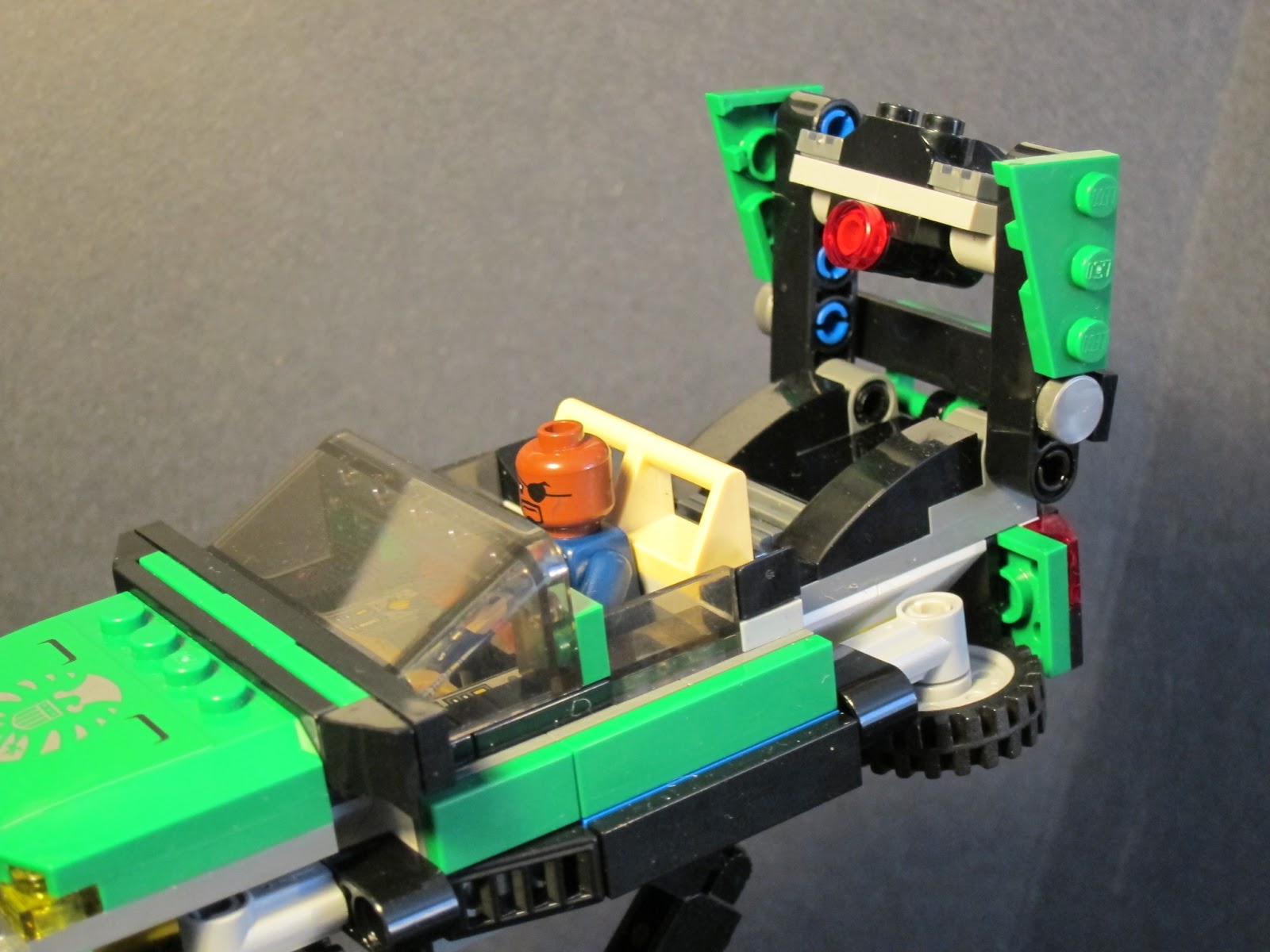

If hover part alone didn't wow you, the S.H.I.E.L.D. car has one more surprise in the form of a missile launcher that rises up from the rear section. The missile is of the "flick" type where a small tube piece is snugged within a slightly larger "launcher" socket hole and putting pressure on the rear section of the missile (such as by flicking it with your fingertip) causes it to "fire."


Next up is the Spider-Man himself and his titular Spider-Cycle. I know what you're thinking, I thought it too.  Let's just say it together and get it out of our systems; Why does Spider-Man need a motorcycle? Much like the question of why Superman would need a clumsy robot walking machine when he could fly, one can't help but wonder how this really helps Spidey's overall performance. 

"Don't hate."
Not that it isn't a sweet little bike, but wouldn't an earth-bound vehicle just slow down a super hero noted for his speed, agility and disregard for gravity? He'd have to abandon it the first time a villain took out a grappling hook or fired up a convenient jet pack, it's not like it can fly...


Oh right, it absolutely flies. Much like Fury's car, Spidey's wild ride can flip it's tires sideways and call them turbofans to take the fight to the skies! Well, probably not much higher than Spidey would be swinging on his webs anyways and with the possibility of mechanical failure or a bird getting sucked into a turbine or... Look! Flying motorcycle! Cool!


You can't really fault Lego for the Spider-Cycle though, super heroes are hard to accessorize and sets with just a few mini figures and nothing else would be boring. Plus, I'm not really up on the Ultimate universe, but I'm pretty sure Spidey works directly for S.H.I.E.L.D. in that continuity, so maybe the motorcycle comes with the badge.


Spidey himself doesn't have quite all of the detailing present on the comic version of the suit, but much like Fury, he's close enough that you're not going to mistake him for anyone else. Also included in the set is a piece composed of a white string with short bars spaced along its length and a cap that can fit over a mini figure's hand or a single stud on brick pieces, meant to simulate Spidey's webline. This is a fun piece that works pretty well for having a figure "swing" from things or for "tying" villains up.

"We HATE you!"   "Yeah, yeah..."
Unfortunately, due to the slack nature of the string, the webline looks less impressive in any sort of pose requiring Spidey to shoot it forward in a classic "slinging" pose. And if you have him holding it while riding the Spider-Cycle like on the packaging, he starts to resemble a different Marvel hero.

"NONE ESCAPE THE SPIRIT OF VENGE- I mean, Spider-Sense tingling!"
Though he's already popped his head in a couple times now, I saved the best mini figure for last, VENOM!


Growing up, I loved Venom. He was an honestly terrifying villain with a very personal connection to Peter Parker and later was my first exposure to an anti-hero before I even knew that word existed when he turned "good." It's a really weird feeling to finally hold in your hand a figure like this after spending so long as a kid thinking about how cool it would be to have Spider-Man Legos. Lego Venom's deco is perfect with the giant white spider logo on his chest and back, huge white eyes, rows of sharp teeth and even lines showing muscle definition on his torso and super-thin lines of pink for gums!


Though he lacks a vehicle like his enemies, Venom has a few accessory pieces to give him a fighting edge. The first is a backpack with a free-spinning hub piece attached that has four clips spread around its edge. Black, spiny tentacle pieces attach to these clips to give Venom array of extended pseudopods for thrashing the heroes with. This rig gives Venom a stretched neck unfortunately, so I prefer to just leave it off.


Venom also has a couple of bricks covered in tentacle and spine pieces that I assume is to represent him throwing globs of his suit as weapons. Not a terrible idea as they would most likely be smart enough to further harm or at least hinder their target once they hit and the main symbiote could probably regenerate the lost mass fast enough. You can also peg or entangle them on and around Fury's car or the Spider-Cycle to muck up the systems.


And while there is only one webline included, Venom can still steal Spidey's and go swinging through the city.

"Well, at least it's not a giant shark..."
To me, the Spider-Cycle Chase is a solid hit. For twenty bucks, you get a large-ish vehicle, a small vehicle and three mini figures with accessories, a good deal for a good set and one that won't break the bank if the kids (or you) really want Spider-Man Legos. The mini figure selection alone is almost worth the asking price, the vehicles are just icing.

Thursday, December 13, 2012

Gentlemen! I have built, THIS THING!: Phage Drone

 Yet another installment of GIHBTT and once again, we're looking at a robotic drone based off a real world animal (sort of), the Phage Drone!

I took less pictures of this one for some reason so I'll have to jump right into the description. This is the Phage Drone, an autonomous robotic unit designed primarily as a deep-space area of denial tactic similar to a remote mine, but with an insidious twist. The drone gets it's name from the real world bacteriophage, a virus type with a bulbous "head" and multiple radial arms attached to a stalk body. The real bacteriophage attaches itself to healthy bacterial cells and injects them with it's genome, turning the bacteria into miniature factories that create endless copies of the phage until they burst. The Phage Drone copies both the bacteriophage's appearance and method of attack, but is well equipped to defend itself in any situation. The drone is shown here in a neutral, "stand-by" stance. Deployed in large numbers from capital ships, the Phages will float in this position in a power conserving state with incredible patience, waiting for a ship to come within range. The orange wedges visible on the head module are it's primary optics, four in total. Since each "face" of the head module sports an eye, the Phage has excellent vision and is difficult to approach unawares. The light gray nozzles at each corner of the head are microthrusters that help keep the drone from drifting off it's assigned path while waiting for targets. Also visible are two of the Phage's four secondary weapons: The gray double-barreled device on the left face is a magnetic acceleration cannon modified to fire short ranged bursts of charged projectiles in a fashion similar to a shotgun. This weapon is primarily intended for use against organic enemies, but can easily punch a hole in starship armor at close ranges. The black harpoon gun protruding from the right face is a pneumatically powered projectile launcher that fires foot long metal spikes. As with the scatter MAC, this weapon is most effective against organic targets, but the Phage can electrify the bolts before firing to cause minor EMP black outs to sections of larger ships or completely overload smaller robotic targets and starfighters.


This shot shows the additional weapons present on the Phage's other faces. The orange and gray stacked discs on the left are a kinetic wave generator whose output can be greatly modulated by the Phage. At it's most powerful setting, the generator can produce waves of force strong enough to rattle a starfighter to pieces, but can be attuned to a setting light enough to merely disorient living targets or render them unconscious by rapidly altering the subject's inner ear pressure.The dark and light gray cannon on the right face is a powerful cutting laser that lets the Phage make it's own entrance into enemy ships, often hiding within the target's hull to avoid external detection.The Phage's head module also spins freely where it meets the body stalk so it can bring any of it's weapons to bear on a target in a split second. Visible in both of these pictures is the Phage's long range communications antennae, with which it can send and receive transmissions from capital ships several star systems away.


Though the Phage certainly has the means to bring the fight to nearly any unit on the battlefield, it rarely needs to use the weapon systems and relies instead on it's sinister primary programming of crippling and destroying enemy fleets. When a Phage Drone detects a hostile ship within it's vicinity, it quietly engages maneuvering jets and drifts forward until within range, sensor-baffling reflective plating preventing it's target from distinguishing the drone from other floating space detritus. Once the drone closes the distance, it extends grasping arms and positions itself above the target's hull (imagine the Phage in the picture without the black pole/gray hub cab base, I don't have any clear "hover" stands). At this point, the secondary optic sensors on the inner surfaces of the arms (the orange wedges) come online and begin scanning the target, looking for vital electrical systems close to the surface. Once such a system has been located, the drone deploys it's primary weapon, the Viral Missile.


The Phage fires the drill-tipped Viral Missile directly into the enemy ship's hull, boring until it strikes the targeted electrical relays. A high tensile, flexible cord packed with fiber optic cables links the drone to the missile and allows it to transmit a debilitating virus directly into the tethered ship's systems. This virus quickly guts the target's central computer and places the Phage in direct control, locking crew members out of the system, disabling life support and escape pods and hijacking the ship's weapons to turn them on allies. The virus prevents both direct and indirect attempts at limiting it's spread or control, even re-routing systems around infected consoles or hardware physically removed from the target. Experts have theorized that it may be possible to eventually undo the damage the virus inflicts and regain control of an infected ship, but the Phage is specifically (and somewhat sadistically) programmed to minimize the chances of such an operation succeeding.


Again, imagine the missile with no base...

Phages have the cruel tendency to open all hatches and air locks to the vacuum of space as soon as they gain control, negating a potential crew uprising almost immediately, often before any personnel realize what is happening or have time to send a distress call to other ships in their fleet. As a result, Phages are considered to be one of the most terrifying weapons in exo-naval warfare, able to lie dormant and nearly undetectable for long periods of time across space lanes before hijacking a ship with no warning and turning it against it's fellows. The drone's own intelligence and high level of independence make it even more dangerous, as multiple Phages will covertly communicate over encrypted short-wave bandwidths and work together to hijack strategically positioned ships within a flotilla secretly, only to reveal their deception once the enemy fleet encounters the Phage's allies, unleashing a surprise attack that can rip formations apart and leave the remnants easy prey for the home fleet. Some concern has been raised over the ethical use of Phages in space combat as the drones are often released in the hundreds of thousands and exact records are rarely kept of every unit deployed to a zone. This shoddy record keeping, coupled with the tendency of the drone's advanced CPU to become "bored" when left floating for long periods of time without directives, results in huge swaths of space within some systems that are incredibly hazardous to traverse to this day, decades after the conflicts that seeded the area with Phages in the first place has ended. Multiple instances of civilian ships being puppeted or outright destroyed by "malfunctioning" Phages that refuse to acknowledge command signals has led many governments to quietly retire the model from their naval forces, but they are still popular among pirates and smugglers as advanced defense systems for less than legal star bases and outposts.

And that's the Phage Drone. It started out from me just fiddling around with random pieces while trying to polish off an unrelated mech design (still unfinished mech design...) and then almost built itself once I thought "Hey, this kind of looks like the head of a bacteriophage..." Besides the bacteriophage itself, the Phage Drone is influenced by the Probe Droids of Star Wars, and to a lesser degree, by the "hovering" Imperial kill Droids of Star Wars in general. If I had the pieces, I would make all it's legs joints ratchets since the current friction joints just can't support it's weight. Also, I'd build it a clear display stand of some sort if I had the pieces because this baby's gotta float to look it's best!


Monday, December 10, 2012

Gentlemen! I have built, THIS THING!: SCUD Drone

Following right on the heels of the Terror Bird & Demon Ninja GIHBTT, I have another build I'm fairly proud of to show you. This time, we're going deep under the sea and combining several nightmare fuel ocean creatures into one laser-wielding death robot, the SCUD Drone!


This guy came about from my having a bunch of dark blue pieces from a Star Wars Tri-Droid set, the light-up brick piece from the Creator Rescue Robot set, lack joint pieces since they are mainly in use in other builds and the desire to bring all those things together. It worked pretty well.


The SCUD Drone is an autonomous, deep water military unit used for a variety of purposes, but primarily as a surprisingly form of underwater artillery. Shown here in it's walking mode, you can see the influence of the creature that inspired it's primary appearance, the Spiny Lobster. The thick, spiky body, tail and antennae, plus the lack of claws is a rough summation of the Spiny Lobster. In this mode, the SCUD freely traverses the ocean floor, surprisingly dexterous in it's ability to climb extremely angled or unstable surfaces. The four stout, reinforced legs give the SCUD a stable grip and can dig into the sea bed to anchor it when firing it's tail cannon. The long, bladed antennae contain a variety of complex sensor systems as one might imagine, but they also serve as the SCUD's primary close range weapons and grasping appendages. The antennae are complex enough to cradle and lift objects as small and fragile (in comparison to a thirty-something foot long robot) as a watermelon, but can also be whipped forward with alarming speed and accuracy to cause severe slashing damage to targets as hardened as the hull of a submarine. Much like the real world mantis shrimp, the SCUD whips with enough speed and force to create cavitation bubbles, the collapse of which creates an additional concussive force on the target seconds before the appendage actually strikes.


At the bases of the SCUD's antennae are a pair of sharpened blades that it can use as both a weapon and a cutting tool if a mission requires it, "feeding" targets into the blades using the highly flexible antennae. Shown here also is the forward weapon exhaust vent (situated between the bases of the antennae) and the third optic sensor mounted on the underside of the SCUD's body that helps it maintain a rock solid footing on the ocean floor by constantly scanning the terrain ahead and beneath it. This sensor, coupled with the powerful primary optic sensors, gives the SCUD an excellent field of vision and a variety of available spectrum scans.


Here is the SCUD's tail, where the artillery portion of it's functions come in. The SCUD's tail actually possesses it's own independent processor that is built solely around advanced targeting systems and firing the powerful particle cannon contained within the "stinger" pod. Operating alone, the tail's systems are advanced enough to gather and compile data from the amount of light reaching the SCUD's optics, pressure changes, water column movement and even the behavior patterns of native sea life to locate and identify enemy targets operating at the surface and beneath the waves and can fire a devastating blast from several miles away. If the tail's systems are linked with those of a friendly surface ship or orbital satellite however, the SCUD can lob arced shots from beneath the water to hit inland or fire precise shots at airborne targets. These types of fire require an additional ramp up of the SCUD's power core to levels that can potentially damage the unit's more sensitive systems if further stress is put on the it, so the drones typically only employ this system from a secure position or when defended by other units. The excessive amounts of heat  resulting from firing the particle cannon was a hurdle in the SCUD's development, one that was cleverly re-purposed into yet another weapon in the robot's arsenal.


From an overhead view, the primary weapon exhaust vents are visible running along the SCUD's flanks. When the particle cannon is fired, the SCUD's systems reroute the resulting heat and steam and releases it through these vents, literally boiling the sea around the SCUD a few seconds after a cannon shot. The SCUD's designers built a separate system that re-routes and stores a portion of this discharge in a mechanism nestled between the drone's antennae stalks. Though it must be used quickly before the heat can dissipate, the SCUD can release this scalding burst in front of itself to boil any biological threats alive. This ability can still be used on land, though it "merely" blasts super-heated air at targets instead of boiling them, but this is no comfort when still enough to cook a man where he stands and completely ignores the most advanced body armor.


I built the light-up brick into the tail to serve as the particle cannon and it can be activated by pressing in the button at the back of the tail pod, as seen here. This is also a good photo for segueing into more about the things that influenced me in the SCUD's design. I already mentioned the Spiny Lobster as one influence and the "underwater artillery crustacean" idea is borrowed from the Crab Cannon of the Star Wars: Clone Wars animated series, but any Zoids fans out there will surely notice another looking at the tail. The SCUD's tail design, from being a super laser to having various flaps and fins surrounding the barrel, is highly influenced by the Death Stinger from the Zoids series. Of course, the SCUD has one final surprise that also evokes a sea-dwelling early invertebrate...


The SCUD reveals the final influence in it's design when it converts to swimming mode, Anomalocaris. Anomalocaris was an early arthropod that swam in the warm, shallow seas of the early to mid-Cambrian period and crushed hard-shelled prey with it's spiked mouth parts.The SCUD mimics the smooth contours of Anomalocaris and swims with powerful undulations of it's body and tail when scuttling around the sea floor becomes boring. Also, the way the antennae fold beneath it's head when swimming is an exact mimic of how Anomalocaris' mouth parts were positioned and the two share a similar body profile. When swimming, the SCUD's weapon exhaust systems seal off their connections to the core and are used to aid propulsion by drawing water into the channels through the vent in the drone's "mouth" and forcing it out through the rear. This also allows quick bursts of movement in nearly any direction the vents can angle to, but prevents the drone from using it's particle cannon until it has purged all water from the system and resealed the exhaust.

So ends another edition of Gentlemen! I have built, THIS THING! I hope you enjoyed the exhaustively detailed account of the SCUD Drone and the mini paleontology lesson about Anomalocaris. Tune in next time for more overly thought out descriptions of Lego robots!

Tuesday, December 4, 2012

Gentlemen! I have built, THIS THING!: Demon Ninja & Terror Bird


First off, I know it's been awhile since I've posted anything (exactly a month it seems) and I apologize. It's not that I've been particularly busy or short of things to write about, I've just been...kinda lazy. I partially blame XCOM: Enemy Unknown. I never played the originals, but this one made me drop off the map for a couple of weeks straight training my troops into psychic operatives and researching the best tech. But I digress. In the spirit of things I haven't done in way too long, I give you a brand new installment of Gentlemen! I have built, THIS THING!


Today I have for you a Ninjago-inspired beast and rider pair that I just call Demon Ninja & Terror Bird. The names are a bit generic I know, but a big part of the spirit of Lego is fleshing out the basics of a story line with your own imagination, so fairly simple names. Plus it sounds a lot better than "I'm not very good at coming up with cool-sounding fantasy names." This whole thing started with the construction of the Demon Ninja rider, so let's start with him.


This guy came about when I was just idly messing around with mini figure pieces whilst trying to put some finishing touches on a larger thing I was building (which may very well show up in a future installment of GIHBTT) and like a lot of things I build, it took on a life of it's own from there.


This guy started life as the Cole from Cole's Tread Assault, but I switched his gear with Kai from Kai's Blade Cycle to make him all black and gray. I had originally popped the Mummy head from the Monster Fighters set of the same name on just for a laugh, but it looks really cool under the ninja head wrap and gave me the idea to make him an evil undead ninja to begin with.


Kai provided "cursed" black swords which look great with him, but I still felt he needed a little more omph...


There we go! I call that sucker the Oni Maul because it somewhat resembles the clubs traditional Oni supposedly carried. It is quite an intimidating weapon if I do say so myself, but it has another surprise yet to unveil.


When things get tough, the Ninja can unhook the spiked head and let it swing from the chain, turning the maul into a long flail! Also, can you tell by the design I was watching the Lord of the Rings movies while building this? Sauron would love that thing!


A fierce warrior deserves a fierce mount and the Demon Ninja receives that in spades with the mighty Terror Bird! The term terror bird refers to a real family of giant (thankfully extinct) flightless, predatory birds that roamed South America during the Cenozoic era. These ten foot monsters ran down their prey on the ancient savannas and finished it off with savage kicks from the huge claws tipping their powerfully-muscled legs and crushing bites from their hooked beaks. Basically, they were bad news for anything not a terror bird in those days. My Terror Bird is designed to be a distant relative of those creatures with a fantastical twist.


Originally, I had wanted to give the bird full, massive wings so the Demon Ninja could survey his territory from on high (again, Lord of the Rings influence seeping in again), the long, angled vanes from Cole's Tread Assault would make perfect feather sections after all. Once I started playing around with designs however, I discovered that I did not have enough ball and socket joint pieces, nor enough large "filler" pieces to make the wings look good, but still retain at least somewhat realistic bird-like folding capability. So instead of a Nazgul-esque flying terror, I re-imagined the concept as desert dwelling evil ninjas taming and riding the native giant, predatory, flightless avians and ensuring no one ever tries to cross that desert again.


Terror Birds are close in physical build to their real world counterparts with with powerful legs, hooked claws for catching and holding prey and a powerful, sharp beak for tearing flesh and crushing bone. These Desert Terror Birds however sport a few differences: Their wings, though greatly stunted, are still a bit longer and more dexterous than real terror birds and they use them to both help secure prey and climb, plus they can deliver a nasty slash with the scythe-like claws at the tips. Terror Birds have also evolved long, prehensile tails that help them balance while running and can also serve as an additional limb when climbing or manipulating smaller objects.


Additionally, male Terror Birds have a two pronged claw at the tip of their tails. In the wild, this is used to help hold a female steady during mating, but Terror Bird riders have trained the males to utilize this claw in battle, using it to catch and then crush enemies, or hurl them long distances with a single twitch of the muscular tail. Females lack the grasping claw, but instead have a single sharp spine terminating their tails which can also be employed as a weapon with proper training, though generally fewer females are trained as mounts due to their less aggressive nature.


The Terror Bird has ball joints at the base of the skull, base of the neck, shoulders, elbows, wings claws, hips, knees and ankles and the jaw, toes and tail are also fully articulated with a series of varying joints. Originally, I was going to have the chain reins be loose at the end so the ninja could hold them directly, but they rattle around too much already as the bit is loose and just fits in the Terror Bird's beak.


Here's a close up of a leg to show off the joints better. Given the proper parts, I would rebuild the legs to be sturdier (besides giving him full wings) because they are a bit weak in spots right now and pop apart or cause the bird to collapse if stretched too far in a pose. For example, look at the knee joint. See the gray rod peaking through just below the gear at the end of the thigh? That's because I fudged a few ball socket joints by using one of those single ball pieces that only a rod can connect to (for an example see, the "ball" in the ball and chain of the recent Monster Fighters Ghost set) and attached it via rod to another piece. The result is a not very stable joint and little things like that just drive my Lego OCD nuts until I fix them. Still, the foot claws came out nice and can totally grab mini figures pretty tightly.


The saddle for the Demon Ninja has enough room for him to either sit or stand and a place for the Oni Maul to clip to on the back. There are also a spear and an ax on either side of the saddle that can be removed (with a bit of hassle) to give the ninja further armament if he needs it.


I'm pretty proud of this one. It took a while to build to my liking, and there are still a few things I'd like to iron out about it's design, but if I saw this as a set in stores when I was a kid, I would have flipped out about it. I really like the Demon Ninja's overall design and think the Oni Maul came out especially nice, it's kind of hard to build a weapon for a mini figure that doesn't look ridiculously over-sized or silly, but this one has justifiable reason for it's size and looks nice no matter how he wields it.

That's it for the Demon Ninja & Terror Bird entry, but I have two more things built that I really want to show you guys and a third that is about 98% complete so even though it was a long hiatus, Gentlemen! I have built, THIS THING! will have more coming down the pipeline soon.

Thursday, April 26, 2012

Lego Mini Figures Series 7 Galaxy Patrol

No Gentlemen! I have built, THIS THING! this week because I've been busy and I'm low on good parts not already in things I've built. But I do have some Lego goodness for you anyways, in the form of the Galaxy Patrol mini figure!


Blind packaged mini and trading figures are nothing new in Japan, but only recently have any American companies started using that angle. Mega Bloks has blind packaged Marvel and Halo figures, Hasbro brought up memories of Monster in My Pocket in their Handful of Heroes packaging with a hidden secret figure and for the last few years, Lego has been releasing waves of blind bagged mini figures available in no other sets. This guy is from series seven and seems to merge the current Space Police line with Classic Space.


He has new pieces in the form of a really nice chest and shoulder armor piece and helmet, his gun is recycled and his main body is obviously a standard Lego body. In a nice touch, his shoulder pads have the Classic Space logo on them that makes me remember to way, way, back.


The armor has a connection point on the front and one on the backpack, as well as two downward pointing "rockets" that other pieces can attach to. Though I don't see you adding much to this guy's armor without making it really bulky and weird looking. The black bar he's standing on is the standard base that accompanies each figure in this line.


His body underneath the armor has a lot of really detailed tampographing, including overlapping plates of armor, a collar piece, pouches on his thighs, and his name, "Luiz", on the left breast of his armor. His head has two sides, the one shown here is scruffy and has a cybernetic eyepiece. Actually, if they made a Lego Commander Shepard from the Mass Effect series, this is probably pretty close to how he would look.


His other face is made solely to be used with his helmet on, which is why I show you a picture with it off. Most of this face is orange to simulate a visor covering his face with the helmet on, which is a clever alternative to using an actual separate piece of translucent plastic. There are a lot of white details indicating distance increments and other readouts projected to his "visor" and he retains his five o'clock shadow. In a nice detail, the eye not using the targeting crosshair is squinting slightly.


Overall, a really cool figure and definitely worth the $2.97 asking price. Since the series is blind bagged, you obviously can't just grab one at a glance, but as his gear is some of the bulkiest in this wave, feeling the bags a bit might help you out. If you don't mind being seen fondling Lego bags in the aisles of Walmart. I didn't. Hell, this guy is so sweet, I might do it a few more times!


Finally, here's a scan of the poster that comes packaged with each figure, showing everyone else in this wave. There are some really awesome ones in here besides the Galaxy Patrol officer, including a hippie, Poseidon, an evil knight, an Evel Knievel alike, and a Scotsman (!) with a kilt (!!) AND bagpipes! (!!!) It's worth hunting them down just for the Scotsman. LEGO BAGPIPES!